The Story of Berserk
Complete synopsis of the manga by narrative arcs
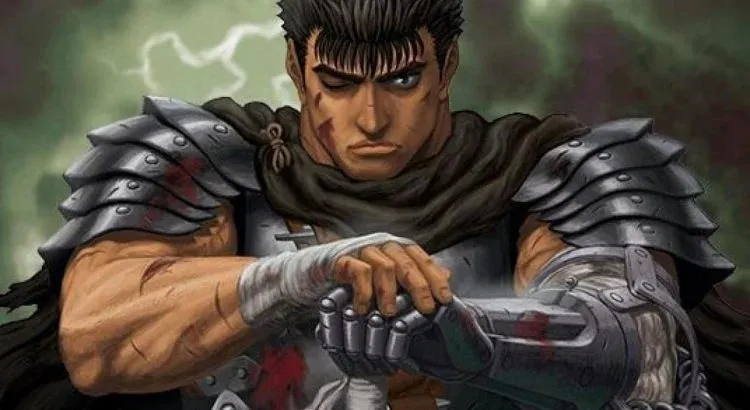
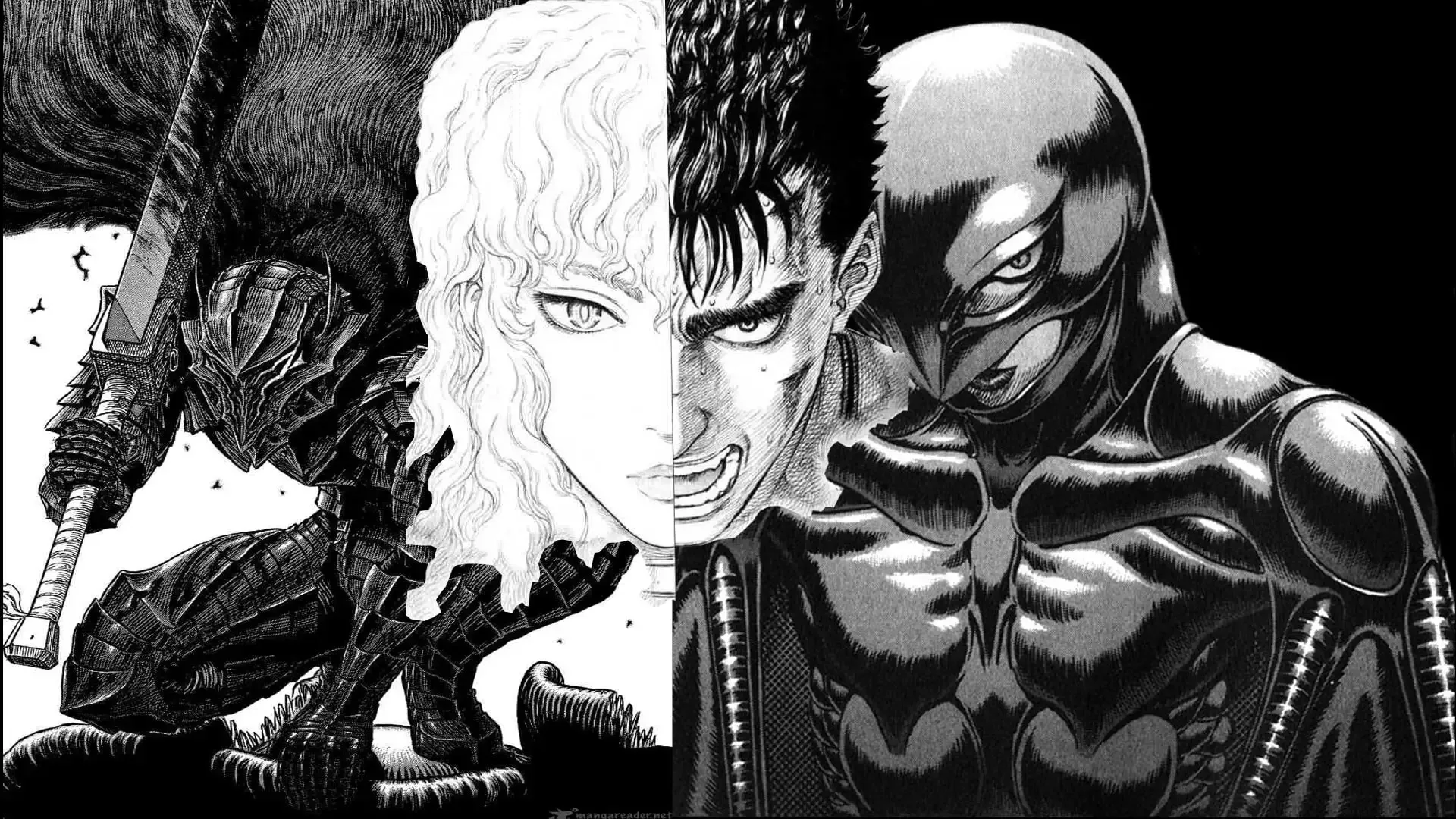
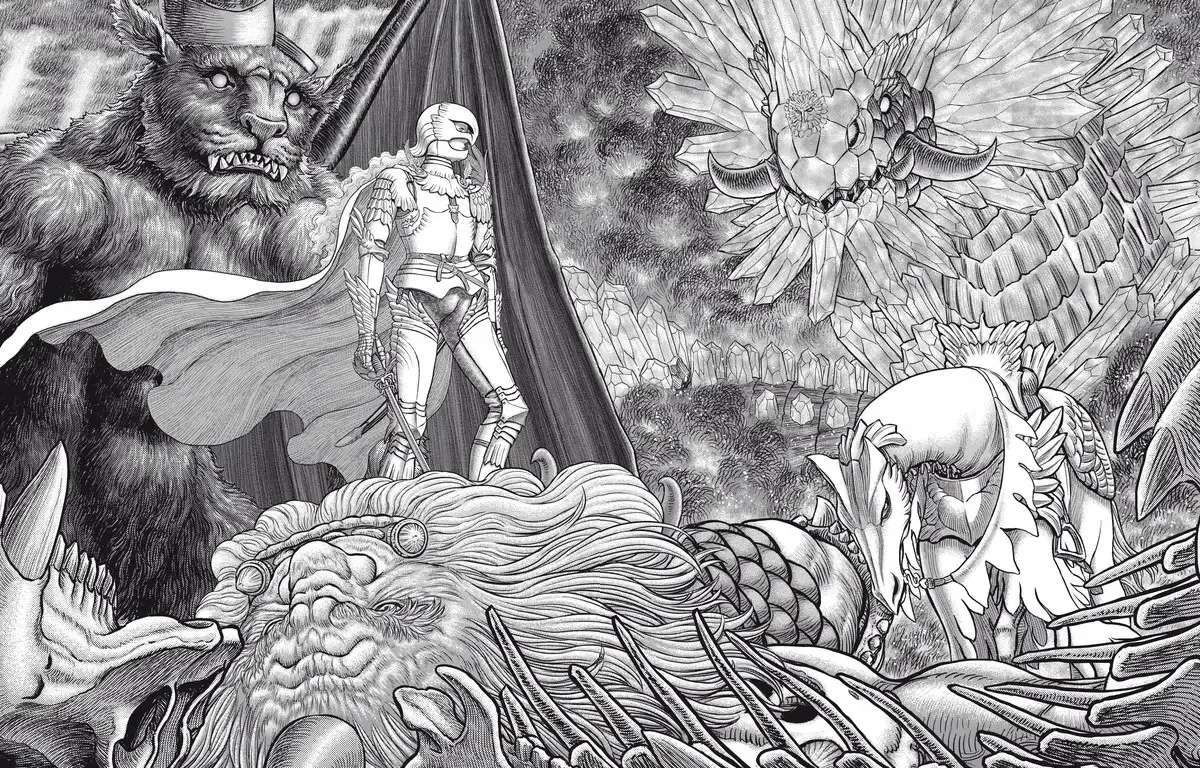
Berserk is a dark fantasy saga set in a fantastical medieval world inspired by Middle-Ages Europe. With rare mastery, the work blends the warrior epic, cosmic horror and a deep reflection on fate, freedom and what it means to be human.
At the heart of the story: Guts, a colossal warrior carrying a two-meter sword and a demonic mark branded on his neck — the Brand of Sacrifice. This mark, which draws creatures of darkness on every full-moon night, is the testimony of an unspeakable betrayal. It is the starting point of a quest for revenge spanning decades and continents.
The major narrative arcs
The Black Swordsman
Volumes 1–2 (prologue)The story opens on Guts, alone, wandering a fantastical medieval world. At night, demons emerge — drawn by the Brand of Sacrifice branded on his neck. He fights alone, armed with the Dragonslayer, his cannon-arm and absolute determination.
This prologue arc immediately plunges the reader into the darkness of the universe. Guts is presented as a broken, haunted man, consumed by hatred toward a target we do not yet know. Questions pile up: who branded him? Why this rage? Where does the scar on his eye come from?
The Golden Age
Volumes 3–13Berserk's central flashback — and its most iconic arc. We meet a teenage Guts, a wandering mercenary, defeated in a duel by Griffith, the charismatic leader of the Band of the Hawk. Forced to join the Hawks, he finds for the first time something resembling a family.
For years, the Hawks rack up military victories in the war of Midland against the kingdom of Tudor. Griffith rises in power, his ambitions exceeding the battlefield. His relationship with Guts — the only rival he respects — is the emotional heart of the arc.
The fall is dizzying. When Guts decides to leave the Hawks to find his own path, Griffith collapses. An act of despair lands him in prison. A year of torture later, mutilated, he activates the Crimson Beherit during a night of cosmic eclipse. What he does next is irreversible.
The Eclipse — Berserk's pivotal moment — is one of the harshest scenes in world manga. Griffith sacrifices the entire Band of the Hawk to the God Hand to be reborn as Femto. Guts loses an arm and an eye, Casca loses her mind. Nothing will ever be the same.
Conviction
Volumes 14–21After the Eclipse, Guts resumes his path alone, consumed by hatred. This arc confronts him with the religious Inquisition — a corrupt Church that burns witches and heretics in the name of faith. Grand Inquisitor Mozgus is one of the series' most striking antagonists: fanatical, cruel, yet convinced he serves God.
Guts finds Casca again — broken, childlike, unable to recognize him. Protecting her despite himself becomes his driving force. Then comes Griffith's reincarnation in a new body. The man Guts thought he had lost forever returns to the physical world, more powerful and elusive than ever.
Millennium Falcon
Volumes 22–34The reincarnated Griffith re-founds a new Band of the Hawk with apostles and monsters as soldiers. The world is at war. The Kushan Empire, led by the demon-emperor Ganishka, invades Midland. Griffith positions himself as humanity's savior, playing both sides: the physical world and the world of darkness.
Guts, meanwhile, heads in the opposite direction. He assembles his own party — Schierke the witch, Farnese, Serpico, Isidro, Ivalera — to find a way to heal Casca. They travel toward the island of Elfhelm, land of the elves and ancient magic.
The arc concludes with a cosmic battle between Ganishka, transformed into a titan of darkness, and Griffith. Griffith's victory triggers the Fantasia — the physical world and the world of darkness merge. Demonic creatures appear everywhere. Griffith builds Falconia, a refuge city that draws humanity under his protection.
Fantasia
Volumes 35+Guts and his companions finally reach the island of Skellig, refuge of the elves and witches. There, Schierke and Farnese dive into Casca's broken soul to rebuild her memory and restore her sanity. The ritual is painful, overwhelming — and it succeeds.
Casca recovers her memories. She recovers Guts. But the memories of the Eclipse are also there, inseparable from the man she loves. The arc explores grief, healing and the question of whether two broken beings can rebuild themselves together.
The world has changed: the Fantasia has transformed geography itself. Falconia is now an all-powerful city-state. Griffith reigns. The final confrontation between Guts and Griffith draws near, inevitable.
Major themes
Fate versus free will
Is causality a prison or a framework? Guts rejects the fate the God Hand assigned him. His resistance is the most human act in the manga — and perhaps the most futile.
The price of ambition
Griffith is the ultimate demonstration that an absolute dream has an absolute cost. Miura doesn't condemn Griffith — he shows what it costs to be willing to do anything to reach one's goal.
Resilience
Guts gets back up every time. Not because he is invulnerable, but because he refuses to stop. His suffering is real, accumulated, visible. Berserk's resilience is not heroic — it is exhausting and human.
The nature of friendship
The question Griffith poses in volume 12 haunts the whole manga: can one truly call someone a friend? Did Griffith and Guts ever really know each other? Is sincere friendship possible between two beings who use one another?